
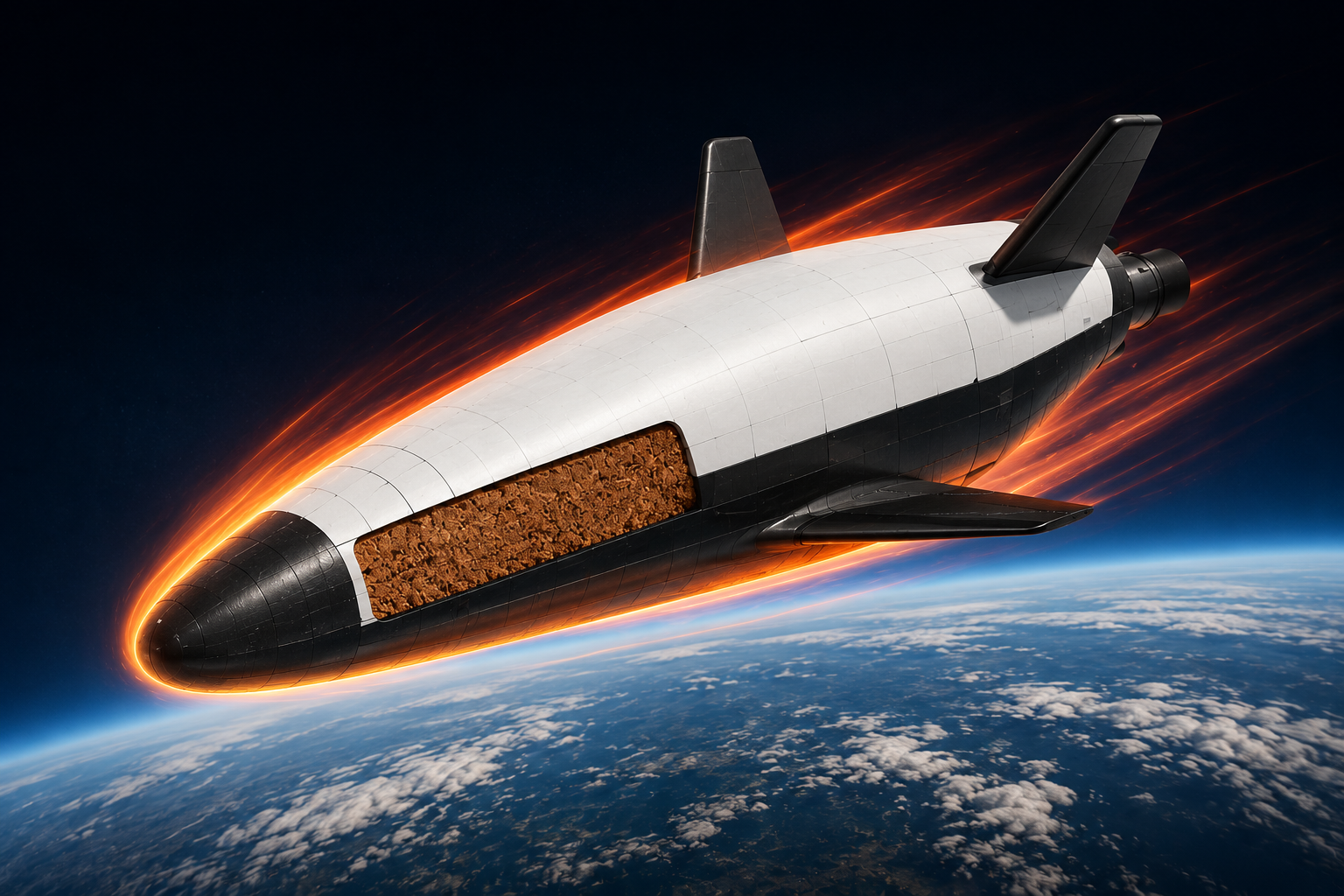
The European Space Agency's IXV spaceplane project is one of the most striking examples of cork's role in high-technology applications. IXV is an experimental spacecraft developed to test atmospheric re-entry technologies. Vehicles of this kind are exposed to extremely high temperatures, friction and aerodynamic loads as they re-enter the Earth's atmosphere.
For this reason, the outer-surface materials used on spacecraft must not only be lightweight; they must also be able to manage heat, protect the structure and deliver reliable performance under extreme conditions.
According to ESA, cork-based ablative material was used on the white surface section of the IXV. Ablative materials, when exposed to high heat, detach from the surface in a controlled way and carry heat away from the vehicle body. This helps protect the internal structure from excessive temperatures.
"Cork-based ablative material carries heat away by detaching from the surface as it heats up."
This use shows that cork can be considered not only in traditional fields but also in applications that demand advanced engineering, such as space technologies. Thanks to its lightweight structure, its behaviour under heat and its protective character, cork stands out as a strategic material alternative in thermal protection systems.
The IXV example is a powerful reference showing how naturally sourced materials can be reinterpreted in modern engineering. In this context, cork is not just a natural and renewable material; it is also a technical protective solution capable of performing under extreme conditions.
The materials used on spacecraft play a critical role in terms of safety and system integrity. ESA's use of cork-based thermal protection on the IXV spaceplane demonstrates that cork is a strong engineering material with real value even in high-technology fields.